AI金属生物绘画:机械生命体与钢铁质感的科幻怪物视觉设计
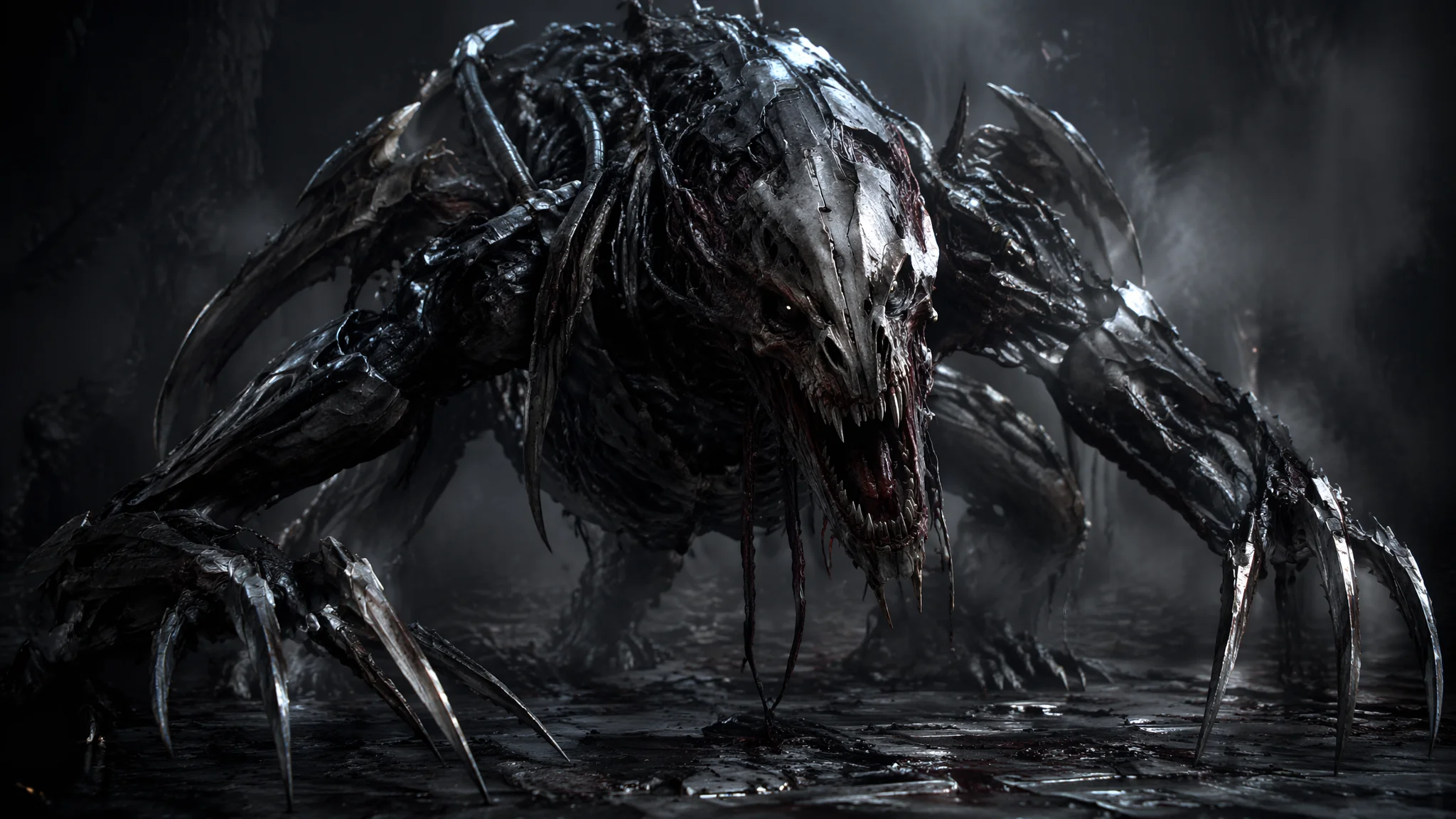
我第一次尝试用AI画"金属生物"是因为看了《环太平洋》——电影里那些巨型机甲和怪兽的混搭让我想试试能不能用AI设计一只"机械和肉体融合的原创生物"。结果第一次出来的图让我直接笑出声——一只看起来像"银色的橡皮鸭"的东西,皮肤是死灰色(AI觉得灰色=金属),身上有几道莫名其妙的直线(AI觉得直线=机械)。完全没有金属的反射感、没有机械结构的逻辑、更没有"这个东西像活的"的感觉。后来我开始研究金属材质的光学原理——不是"怎么画金属"而是"金属为什么看起来是金属"——从反射率到菲涅尔效应到磨损痕迹的叙事功能。搞清楚这些之后,金属生物的Prompt质量直接从"搞笑橡皮鸭"跳到了"可以拿去做概念设计的水平"。
金属材质的视觉本质——不是颜色是光学行为
金属和非金属在视觉上的核心区别不是颜色——是光在表面上的行为方式。非金属(皮肤、木头、布料):光打上去,大部分被吸收或漫反射——所以表面颜色由物体本身的色素决定,高光区域只是比周围亮一点点。金属:光打上去,大部分被镜面反射——所以你看金属看到的不是"金属的颜色"而是"金属反射了什么环境"。这就是为什么不锈钢在蓝天背景下看起来是蓝色的、在夕阳下看起来是橙色的。AI不理解这个物理原理——所以写"metal"它只输出"灰色表面"。
写出真正金属感的方法:不写"metal"——写"mirror-like reflective surface"。具体到Prompt:"the creature's armored plates behave like polished mirrors——each plate reflects a distorted view of the surrounding environment: the sky above appears as a blue-white blur on the top-facing plates, the ground below reflects as dark smudges on the underside, nearby light sources create bright pinpoint specular highlights on the edges of the curved surfaces"。再加环境反射的叙事功能:"the reflections on its body tell you where it is——the glow of neon signs reflected in its chest plates suggests an urban setting, the orange flicker of fire reflected in its face plate suggests destruction nearby——you understand the environment by reading the reflections on the creature, not by seeing the environment directly"。金属成为"场景的镜子"——这个思路来自工业光魔的材质渲染方法论和ArtStation上大量硬表面设计作品——金属表面是场景的"第二显示器"。
机械结构的"功能可读性"——让观众一眼看懂这个零件是干嘛的
AI画机械生物最容易犯的错误是"为了机械而机械"——在身体表面随机画齿轮、管道、铆钉——看起来像一个"金属质感贴图"贴在了一个动物轮廓上。好的机械生物设计遵循"功能可读性"原则:你画在生物身上的每一个机械零件,观众应该能猜出它的功能——即使猜错了,至少能看出"这里在发生什么事情"。
功能可读的设计方法——为每一个机械部件写一句"功能注释",然后把注释翻译成视觉Prompt。举例——"胸腔内可见一个透明的球形舱室,内部有发蓝光的旋转环——这是它的能量核心"→"a transparent spherical chamber embedded in the center of its chest——inside the chamber, concentric rings of blue-white energy rotate around a central core, the rings spin at different speeds creating a mesmerizing mechanical rhythm, the chamber is protected by a ribcage-like arrangement of curved steel beams"。再举例——"后腿关节处有液压活塞,每一步都会喷出蒸汽"→"hydraulic pistons built into the joints of its hind legs——each piston is a thick chrome cylinder with visible seals and oil residue, when the creature takes a step, compressed steam vents from exhaust ports near the pistons with a visible puff of vapor and a subtle orange glow from the heated metal"。
功能可读性的一个实用测试:遮住这张图,用文字向一个没看过的人描述这个生物——如果对方能凭你的描述画出差不多的东西——那这个设计就是功能可读的。关于机械设计的更多技巧在AI军事堡垒绘画中也有交叉——军事装备的机械逻辑和金属生物的机械逻辑共享同一套"功能可读性"原理。
金属生物的"演化生态"——它为什么长成这样
普通科幻怪兽和让人记住的金属生物之间的差距——在于有没有"演化逻辑"。不是"设计师觉得这样很酷"——而是"这个生物在它的虚拟生态位中,这些金属结构是解决什么生存问题的"。比如一只在强酸性大气中生存的金属生物——"its body is covered in thick chromium plating with visible acid-etched pitting and discoloration, the joints are protected by overlapping corrosion-resistant ceramic seals, its breathing vents are filtered with copper mesh that is visibly green from oxidation——because the atmosphere literally eats metal"。每一个金属特征都对应着一个环境压力。
另一个例子——一只以矿石为食的金属生物:"its jaw is a massive hydraulic crusher designed to break apart mineral deposits——the teeth are not biological enamel but industrial diamond-tipped grinding plates that rotate like a rock crusher, the throat contains glowing furnace-like internal heat where ingested minerals are smelted, vents along its spine release waste slag as molten orange streams"。演化逻辑不只让设计更有深度——它让AI更容易画出合理的东西——因为当你把"为什么"写进Prompt时,AI的生成就有了因果关系而不是随机拼凑。
金属生物的五种主流视觉风格——从柴油朋克到生物机械
柴油朋克金属生物(Dieselpunk):"a massive metal creature built like a walking battleship from the 1940s——riveted iron plates painted battleship gray, smoke stacks protruding from its back belching thick black diesel smoke, piston-driven legs with exposed crankshafts and flywheels, gauges and pressure valves visible on its exterior like the control panel of a submarine, the design language is heavy brutal industrial——no sleek curves, everything is thick cast iron and welded steel"。
赛博朋克金属生物(Cyberpunk):"a sleek predatory metal creature with a carbon-fiber exoskeleton and chrome cybernetic enhancements——its body is a mix of matte black composite materials and mirror-polished metal, LED light strips run along its spine and limbs pulsing with neon pink and cyan light, its eyes are multiple camera lenses of different sizes arranged asymmetrically, data cables and fiber optic strands are woven into its synthetic muscle fibers"。参考CGSociety的硬表面设计挑战——不同流派的机械设计语言差异极大。
生物机械风(Biomechanical):"a creature where the line between machine and organism is deliberately blurred——its metal armor has grown organically like a shell rather than being manufactured, the surface has a bone-like texture but is clearly metallic, joint mechanisms resemble ball-and-socket skeletal joints more than industrial hinges, the creature looks like it evolved on a world where biology and machinery converged millions of years ago"。生物机械是金属生物中艺术可塑性最高的方向——也是AI腹肌帅哥绘画里讨论过的"有机形态+精确控制"的技巧在另一个题材上的应用。
纳米集群风(Nano-swarm):"the creature is not made of solid metal plates but is composed of millions of tiny metallic particles held together in a creature-like shape by electromagnetic force——its body has a fluid shifting quality, the surface ripples and reforms constantly, individual particles catch the light creating a shimmering cloud-like appearance, the silhouette holds a recognizable form but the edges are fuzzy and ever-changing"。
古代金属生物(Ancient Metal):"a metal creature from a forgotten civilization——its body is made of tarnished bronze and weathered copper, covered in ancient engravings and hieroglyphic-like patterns, verdigris patina in the recesses, the mechanical parts use primitive but elegant gear systems that look more like an astrolabe or ancient astronomical clock than modern machinery, glowing runes are embedded in the metal surface"。古代金属风的要点是"文明的痕迹"——不只是金属材质,还有制造这个生物的文明留下的视觉指纹。
常见问题
金属生物和环境互动时怎么处理——比如在雨中、沙漠里、水下?
金属和环境互动是让金属生物"活过来"的关键。雨中——"rainwater sheets down the metal surfaces in uneven rivulets following the contours of the armor plates, water beads on the oiled surface, raindrops hit the hot exhaust vents and instantly vaporize into small puffs of steam"。沙漠中——"fine sand has accumulated in the crevices between armor plates, the metal surfaces are scoured to a matte finish by sandblasting winds, heat shimmer rises from the sun-heated metal creating a mirage-like distortion around the creature"。水下——"the metal surfaces are covered in a thin layer of marine growth——barnacles on the older armor plates, green algae in the recessed areas, when the creature moves, clouds of rust particles trail from the joints into the water"。环境互动让金属不再是一块"反光的灰色物体"——而是世界的一部分。
为什么AI总是把"金属生物"画成"穿着盔甲的普通动物"?
因为AI训练数据中"动物+金属"最常见的组合就是"穿盔甲的马/狗/龙"。打破这个模式的关键词:"the creature's biology IS metal——it is not an animal wearing armor, it is a lifeform whose tissues and organs are composed of inorganic materials, its muscles are bundles of tensioned steel cables, its blood is molten metal visible through transparent vessel walls, its bones are forged alloy beams, there is nothing organic underneath——the metal is the creature"。"the metal IS the creature"这句能从根本上改变AI的理解框架。
如何让金属生物"有表情"——金属脸怎么做情绪?
金属脸没有皮肤和肌肉——表情靠机械运动来传达。愤怒——"the armor plates around its face shift and angle forward aggressively——the eye lenses narrow to thin slits, protective shutters close partially over the glowing optics, vents on the sides of its head open wider releasing more steam"。痛苦——"one of its eye lenses flickers erratically, hydraulic fluid leaks from a crack in the faceplate like tears, the head droops and the neck pistons are visibly struggling"。好奇——"the head tilts mechanically with a slight whir of servos, the eye lenses dilate wider to take in more light, a secondary set of smaller sensor lenses extends from the temples"。机械表情的运动逻辑来自AI绘画不换脸中讲过的"表情是运动模式不是静态形状"的原理。