AI军事堡垒绘画:防御工事与钢铁要塞的硬核战争场景视觉创作
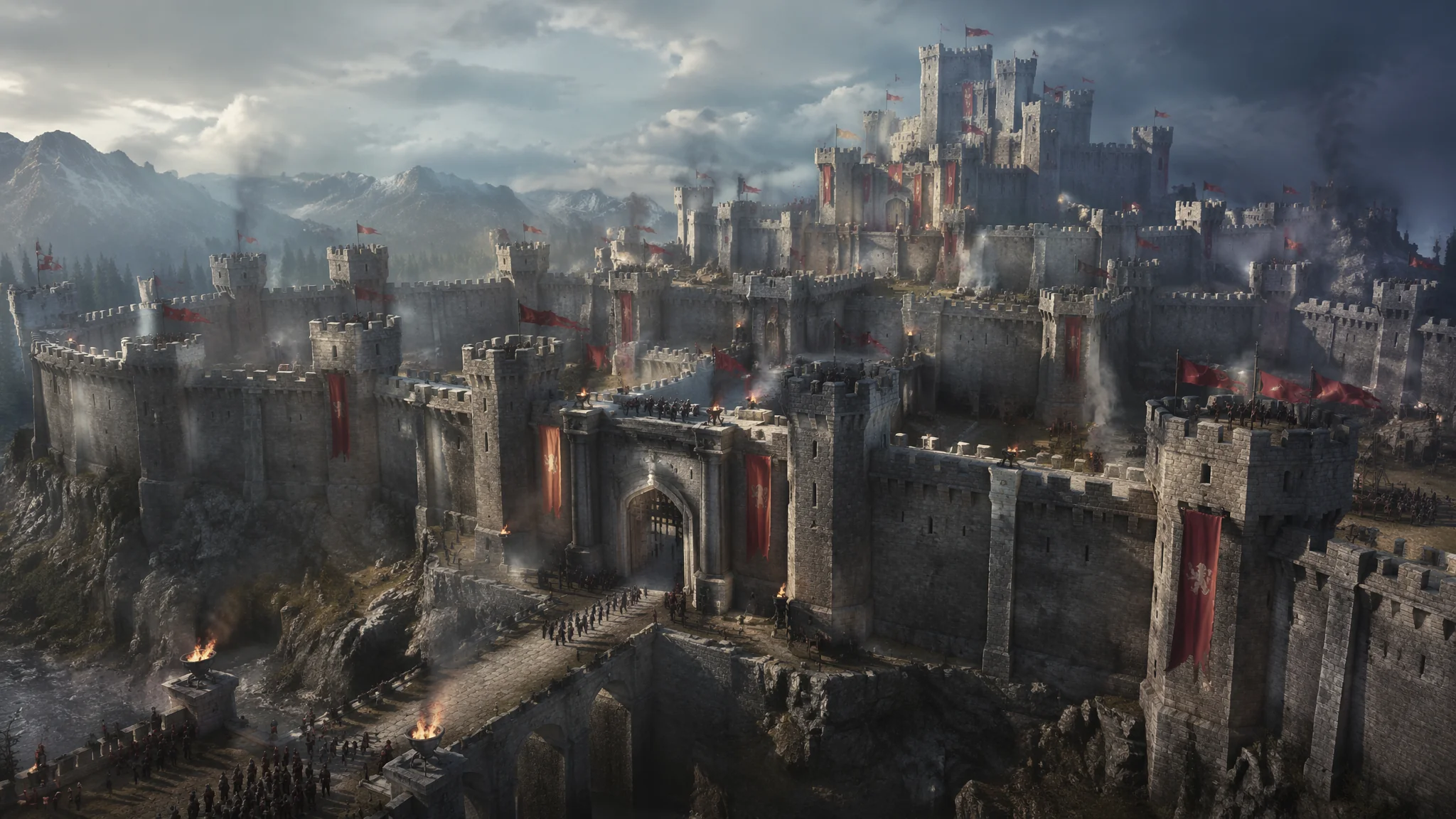
我是个轻度军迷——不到收藏模型的程度,但看到好的军事概念设计会盯着看半天。去年用AI画"钢铁要塞"——我输入"a massive military fortress made of steel, sci-fi war scene"——出来的东西让我愣了几秒:一座看起来像"巨大的灰色婚礼蛋糕"的建筑,上面插了几根像是炮管又像是烟囱的圆柱体,天空是莫名其妙的紫色。我意识到我对军事建筑的结构一窍不通——防御工事的棱角为什么是那个角度?城墙上的射击孔为什么排成那个间距?钢铁结构的连接节点长什么样?这些问题不搞清楚,AI画的军事堡垒永远是一堆"看起来很厉害的方块"。之后我花了两周啃军事建筑的资料——从文艺复兴的棱堡到现代的钢筋混凝土要塞——搞清楚防御工事的几何逻辑之后,AI出图质量直接跳了两个台阶。这篇就是这两周的总结。
防御工事的几何原理——棱角、纵深、火力覆盖
军事堡垒的每一个几何特征都有战术原因——不是因为"设计师觉得这样很帅"。棱角(bastion):城堡从圆形或方形演进为星形,核心原因是交叉火力。圆塔或方塔的侧面有射击死角——攻方士兵可以贴着墙根躲在死角里不被守方火力打到。星形棱堡的角突出于城墙主体——站在棱角上的守方可以回头射击相邻墙面的墙根——死角被消除了。"the fortress walls are not straight lines but a zigzag star-shaped plan——each outward-pointing triangular bastion is positioned so its flanks can fire along the adjacent sections of wall, the geometry is precisely calculated: the distance between bastions must be within effective musket or cannon range so that the entire perimeter is covered by overlapping fields of fire"。
纵深(defense in depth):真正的堡垒不是一道墙——是外壕沟、斜堤、外墙、主墙、内堡——一串层层递进的空间序列。"the fortress has multiple defensive layers visible in the composition——the outermost layer is a wide dry moat with steep scarps and counterscarps, beyond the moat is a gently sloping glacis (cleared earth slope) that funnels attackers into kill zones, the main curtain wall rises behind with bastions at regular intervals, and at the highest point inside the walls an inner citadel provides the last line of defense"。火力覆盖(fields of fire):射击孔、炮眼、机枪巢的布置不是随机的——每个射击口有一个明确负责的扇形区域。"gun embrasures are visible at multiple levels and their placement tells the story of the fortress's defense plan——the lower embrasures cover the moat and glacis at close range, the middle embrasures cover the approaches at medium range, the upper embrasures fire over the lower defenses into the far distance, together they create a three-dimensional kill zone"。
把这些几何逻辑写进Prompt不是"炫技"——是告诉AI"这是一个有军事工程逻辑的建筑,不是一个堆砌的几何体"。关于军事建筑的更多底层原理参考Britannica的fortification词条和帝国战争博物馆的防御工事档案——这些资料里有精确的结构图和轴测图——比文字描述直观得多。
四个时代的堡垒视觉风格——石头、钢铁、混凝土、科幻
中世纪石堡(Medieval Stone):"a medieval stone castle reimagined as a functional military fortress——thick curtain walls of rough-hewn gray stone blocks of irregular sizes, the stone surface is weathered with centuries of rain and moss, crenellations (battlements) with merlons and gaps along the top, round towers at the corners with conical roofs of weathered slate, a heavy iron portcullis partially raised at the gate, boiling oil spouts (machicolations) projecting from above the gate"。
近代棱堡(Bastion Fort):"a star-shaped Vauban-style fortification from the gunpowder era——low thick walls made of brick faced with stone, the walls are angled and sloped to deflect cannonballs, the bastions are wide earth-filled platforms with cannons mounted on the top, the surrounding moat is broad and flat with a stone counterscarp on the outer edge, the overall profile is low and spread out——designed to absorb cannon fire by being hard to hit rather than hard to break"。关于棱堡的几何更多细节见AI金属生物绘画中讨论过的"功能决定形式"原理——国防工事是这条原理最极致的体现。
二战钢铁碉堡(WW2 Steel Bunker):"a World War 2 era fortified bunker complex——reinforced concrete structures with steel blast doors, the concrete is gray and shows formwork marks from the wooden molds used during construction, steel loopholes and firing slits are narrow horizontal gaps at strategic heights, the bunkers are partially buried in the earth with only their fighting positions exposed, camouflage netting draped over parts of the structure, sandbags stacked around gun positions, the design language is purely functional with no ornamentation"。
科幻钢铁要塞(Sci-Fi Steel Fortress):"a futuristic military fortress built on an alien world——the structure is a colossal ziggurat of angular black steel plates with glowing blue energy shield projectors at each corner, railgun batteries on retractable platforms, drone launch bays visible as honeycomb-like openings in the lower levels, the scale is inhuman——a single landing pad is large enough for a battleship, the fortress is wreathed in steam from its massive cooling systems, searchlights sweep the dark sky"。科幻方向提供了最大的视觉自由——但底层仍需要遵循"防御工事"的几何逻辑。
战争场景中的"叙事瞬间"——不是"在打仗"而是"这个瞬间在说什么"
最无聊的战争场景是"双方在打架"——有爆炸有火光有人但不知道为什么打、谁占上风、下一秒会怎样。好的战争场景捕捉的是一个"叙事瞬间"——画面定格的这1/500秒里,正在发生一个可以被讲述的故事。三种高张力的叙事瞬间:一,攻守对峙——双方都在但没有交火。"a tense standoff——the defenders on the fortress walls are completely still, every gun trained on a single approaching envoy or vehicle crossing the no-man's land, the silence is deafening, the moment is the inhale before the storm, a single wrong move will unleash everything"。
二,堡垒被攻破——不是"破了之后"而是"正在破的那个瞬间"。"the exact moment of breach——a section of the outer wall has been blown open by artillery, debris is still in the air frozen mid-collapse, through the breach defenders are scrambling to form a secondary line while attackers begin pouring through the gap, the lighting tells the story: the defenders are in shadow with their backs to the wall, the attackers are silhouetted against the fiery glow of the bombardment behind them"。三,战后的寂静——打完了,胜负已定。"the silence after the battle——the fortress still stands but is scarred and smoking, a single flag hangs limp in the still air, scattered equipment lies abandoned on the battlefield, the dead have been removed but their traces remain, a lone figure walks across the empty field toward the fortress gate"。叙事瞬间的选择决定了这张图是"信息性的"还是"故事性的"——后者让人盯着看很久。
磨损与损伤——让堡垒有"历史"的材质叙事
工业产品看起来像玩具的根本原因是"太新了"——没有使用痕迹的东西缺乏真实性。军事堡垒的磨损叙事分三种:一,战斗损伤——弹孔、爆炸冲击痕、烧蚀。"the fortress walls bear the scars of previous attacks——craters from artillery shells pock the face of the concrete, the steel blast doors are dented and scored by shrapnel impact, scorch marks fan upward from gun ports where the muzzle blast has blackened the surrounding surface, sections of railing are twisted and bent"。二,环境侵蚀——锈、苔藓、风蚀。"steel surfaces show advanced weathering——orange rust bleeding from joints and crevices, water stains running vertically down the walls where rain has followed the same paths for years, patches of dark green moss in areas perpetually in shadow, wind-blown dust and sand have scoured the paint from the windward faces"。三,使用维护痕迹——补丁、加固、临时修复。"the fortress shows evidence of continuous maintenance and improvisation——newer armor plates welded over damaged sections in mismatched colors, sandbags stacked in patterns that reveal they have been there long enough to grow weeds, cables and hoses running across walls in paths that were clearly added after construction"。
这些痕迹不是"让画面更真实"的装饰——它们本身在讲故事:这个堡垒经历过什么、驻守了多久、补给状况如何。关于材质叙事在更多场景的运用,AI金属生物绘画讲了类似的磨损逻辑——从金属生物到军事建筑,材质的叙事功能是一脉相承的。
常见问题
AI画的堡垒比例总是"不像真的"——怎么控制建筑与人物的大小关系?
堡垒比例失控是最常见的问题——AI会随机放大或缩小堡垒相对于人物的尺寸。控制方法:在Prompt中给人一个具体的位置和与建筑元素的相对关系。"a soldier stands on the lower terrace of the fortress——his head reaches exactly the mid-point of the gun embrasure opening beside him, this gives the viewer a clear understanding that each embrasure is about 2 meters tall and the main wall is approximately 15 meters high based on the visible number of embrasure levels"。用人物作为比例尺——不是笼统地写"a soldier next to a fortress"——而是写"士兵的头到达射击孔的中间位置"——这个关系锁定了士兵和建筑的大小比例。
战争场景的光影太"干净"了——怎么让光有"战争质感"?
干净光=单一光源、清晰阴影、正常色温。战争光=多光源混杂、阴影被烟雾柔化、色温偏移。"the lighting is a chaotic mix of multiple conflicting sources——the cold blue-white of searchlights cutting through orange flames from burning fuel, the harsh yellow strobe of explosions casting sharp but brief-edged shadows, the ambient light is filtered through layers of smoke and dust creating a sickly diffuse pallor, shadows are not crisp——they are soft and multiple, each object casts several faint shadows in slightly different directions from the various light sources"。
想画"被包围的堡垒"——怎么表现包围的压迫感而不是"一堆人在城外"?
包围感的视觉关键:城外不是"有一些敌人"——是"城外的整个地面都被敌方占据,地平线上看不到友军的任何痕迹"。"the fortress is completely encircled——the ground outside the walls as far as the eye can see is covered with enemy encampments, siege lines, and artillery positions, the landscape itself has been transformed: trenches zigzag across what was once farmland, the trees have been cut down for siege engines, the entire world outside the walls belongs to the enemy, the fortress is an island of resistance in a sea of threat"。包围的压迫感来自"视线的尽头还是敌人"——不是"城外有一群兵"。